 Online Training

Link Budget Fundamentals
Theory and practice for analyzing point-to-point RF and microwave links and links through bent-pipe satellites.
Course Description
A classic link budget is an analysis of the strength of a signal as it passes through a radio, microwave, or satellite link, as well as the noise generated within the link. The result of the analysis will determine if the link can deliver an error-free (or almost error free) connection.
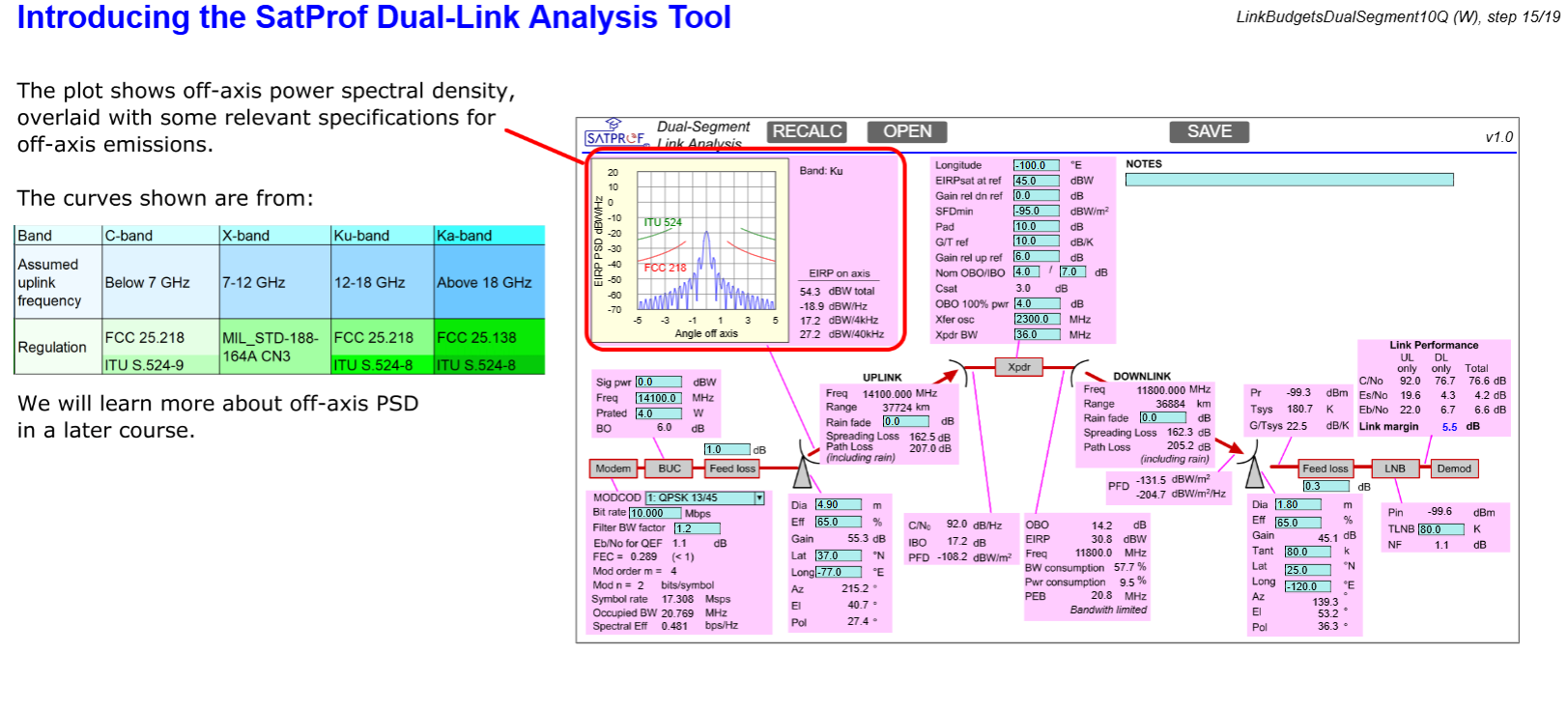
In this course, you will learn how to analyse both simple point-to-point (single-segment) links and links through satellites with "bent pipe" transponders (dual-segment). We will explain all the equations so you will be able to make your own link analyses by hand, but you can use the included simulators to do all the calculations for you.
Included with the course are a 16-page Quick Reference Guide, containing all formulas and constants, plus access to the SatProf Toolkit desktop app which contains RF calculators and single- and dual-segment link budget simulators.
Audience:
This course is recommended for engineers who are planning satellite or microwave links or wish to gain a deeper understanding of commercial link budget software data and results.
Prerequisites:
The following courses are recommended (unless you already have equivalent knowledge): GVF 505 (RF and DC Theory for Satellite Systems, GVF 520 (Satcom Fundamentals), and SBQ403 (Space Communications Fundamentals).
Delivery:
Animated & interactive HTML5, self-paced, on-line format. Requirements: internet access while studying the course material (high speed preferred ); current browser with JavaScript enabled; permission to access SatProf server and learning system websites; mouse.
Tests:
Each lesson contains a mandatory quiz. All pages must be viewed and all quizzes must be passed in order to satisfactorily complete the course. Some lessons also contain Skills Tests using link simulators which you must also pass.Lessons Included
- Introduction
Why do we need to calculate link budgets? Why are satellite signals so weak? Link terminology. "stir fry" engineering. Link budgets are all about noise.
- Noise and Signals
dB, dBW, dBm review. Gains and losses. What is noise? Noise mathematics. Noise power and bandwidth. Adding noise powers. Carrier to noise ratio (CNR). Combining CNRs. Skills tests: dB calculations.
- Transmission
Symbols, bits, rates. Eb/No, Es/No, and C/N formulas. Bit errors, BER, and CNR. Modulation and coding. Choosing a MODCOD. Shannon's limit.
- Ground Systems Fundamentals
Frequency and wavelength. Antenna size and gain. The isoptropic antenna. Antenna efficiency. Antenna types. Antenna noise temperature with and without rain. Noise figure and factor. Noise from losses before the LNA/LNB. Downlink G/T. Transmit EIRP. How to size an amplifier.
- Predicting Single-Segment Links
Four methods for point-to-point link analysis: path loss, spreading loss/PFD, CNR and G/T, Friis formula. Examples and practice calculations. Using the SatProf signal-segment link simulator. Skills tests: making single-segment link budgets.
- Transponder and Satellite Architectures
Classical bent pipe transponders. Saturated, psuedo-digital, and on-board processing transponders. LEO and MEO link issues.
- Bent Pipe Transponder Behavior
Coventional GEO payloads. Translation frequency. Uplink G/T. Saturated EIEP. Saturated Flux Density. PAD settings. Accounting for footprint contours. OBO-IBO and Csat. Transponder bandwidth and power cost. Power Equivalent Bandwidth (MHz equivalent PEB). Calculating range to the satellite.
- Predicting Dual-Segment Links
Gathering parameters. Signal power in the transponder and the receiving antenna. Uplink, downlink, and combined C/No. Converting C/No to Eb/No. Computing transponder PEB consumption. Worked examples with the dual-segment simulator. Practice exercise and skills test: link planning.
- Advanced Topics
Regulatory constraints. VBR and ACM. Sharing transponder power. How to mitigate rain effects. Availability. Rain zones. Scintillation and refraction. Fresnel zones.